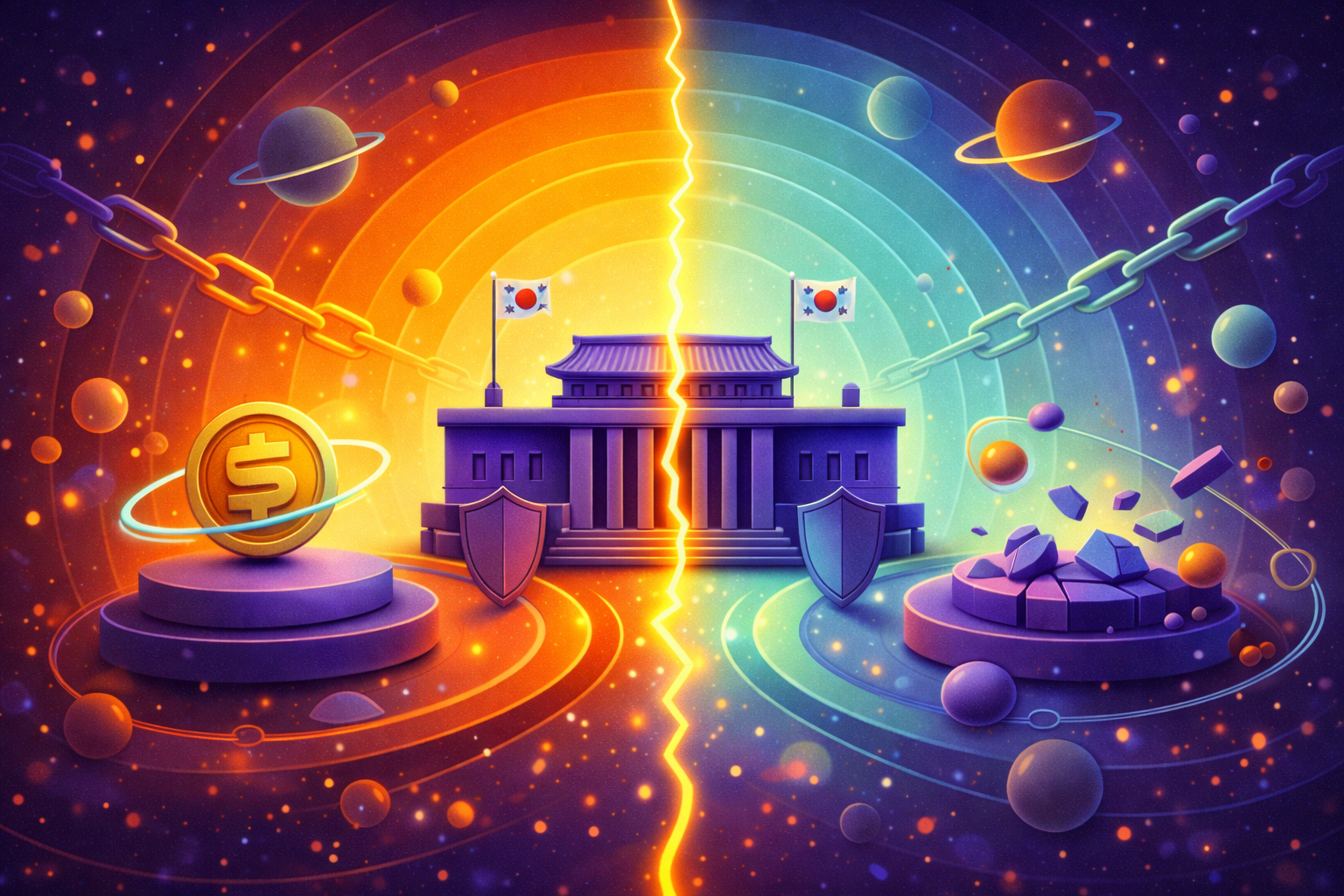
As global adoption of cryptocurrencies accelerates, South Korea is moving to establish a clearer regulatory framework for its digital asset sector. According to local media reports, the government’s long-awaited digital asset bill is expected to be unveiled by the end of the year. Far from a procedural formality, however, the draft legislation has sparked intense debate behind closed doors.
At the centre of the discussion is whether banks should retain dominant control over the issuance of stablecoins — and what that would mean for major foreign issuers such as Tether (USDT) and Circle (USDC). A recent consultation between the Democratic Party’s digital asset task force and private-sector experts made one thing clear: consensus remains elusive.
The “Banking Consortium” Model: A Brake on Innovation?
The main divide has emerged between the Bank of Korea (BOK) and industry and academic experts. The central bank has taken a cautious stance, proposing that the issuance of won-denominated stablecoins should be led primarily by banking institutions.
Under the proposal, authorisation would be granted only to consortiums in which banks hold at least 51% of the equity. While designed to safeguard financial stability, critics argue that such a structure could undermine competitiveness and slow innovation.
At a consultative meeting held on October 23, several experts voiced concerns about the model. Ando Geol, secretary of the working group, summarised the sentiment at a subsequent press conference:
“Many experts have expressed concerns about the ‘51% banking consortium’ model proposed by the Bank of Korea. It is difficult to expect strong network effects and meaningful innovation from stablecoins governed under this structure.”
For many market participants, confining stablecoin issuance within traditional banking frameworks risks limiting the flexibility required for the development of decentralised finance (DeFi).
USDT and USDC: A Potential Obligation to Establish Local Operations
Another central component of the bill concerns foreign-issued stablecoins, which currently dominate global markets — notably USDT and USDC.
To align its framework with international regulatory standards, the South Korean government is reportedly considering requiring foreign issuers to establish a local entity in order to distribute stablecoins domestically.
Under such a rule, for example, Circle would need to create a Korean subsidiary for USDC to circulate officially within the country. The proposal mirrors regulatory approaches seen in other Asian financial hubs.
In Hong Kong, the creation of a local entity and the acquisition of a licence are required for official issuance, although exchange trading remains permitted. In Japan, issuance and distribution are restricted to banks and trust companies, with foreign firms required to partner with local institutions.
While policymakers broadly support this push for regulatory alignment, several operational uncertainties remain.
How would major exchanges such as Upbit and Bithumb be treated under the new regime? Would platforms be required to delist foreign stablecoins if issuers fail to establish a domestic presence? Without a local structure, services such as direct redemptions could become operationally complex, potentially affecting user experience and market liquidity.
A Tight Legislative Timeline for January
Although the government has submitted its proposal, progress has reportedly slowed due to ongoing differences with the Bank of Korea. The Democratic Party, which is advocating for a faster rollout, has urged the Financial Services Commission to finalise the framework promptly.
MP Ahn outlined the tentative political schedule, stating: “I expect the government’s bill to be published by the end of this year or early next year. On that basis, the Democratic Party will review the key provisions in January and accelerate the legislative process.”
The coming weeks are therefore likely to prove decisive. South Korea must strike a delicate balance between protecting monetary sovereignty and ensuring it does not isolate itself from the rapidly evolving global crypto market.
Source: News 1 Korea