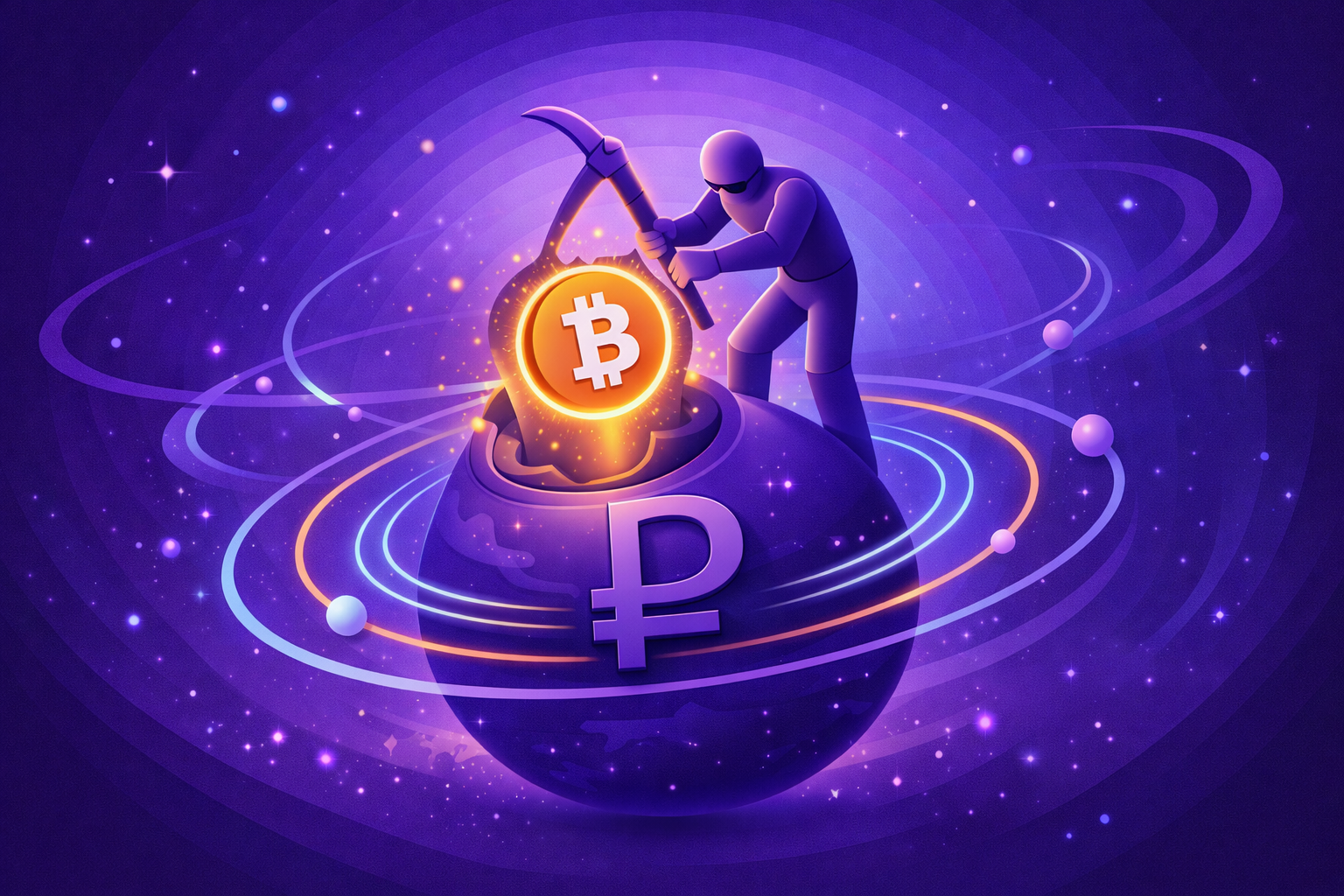
Elvira Nabiullina, Governor of the Russian Central Bank, has suggested that Bitcoin mining could influence the ruble.
Mining activity in Russia now represents a significant share of the global hashrate. This development comes amid international sanctions and the gradual implementation of cryptocurrency regulations.
Context: a growing mining sector
Cryptocurrency mining was legalized in Russia in 2024 after several years of restrictions. Since then, the country has significantly expanded its mining capacity, reaching an estimated 15.5% of the global hashrate by the end of 2025, according to the Hashrate Index.
The central bank governor believes that this activity could support the ruble, although it remains partly within a regulatory grey area.
Maxim Oreshkin, economic adviser to President Vladimir Putin, has also described mining as a “new export product.” He argues that these financial flows, which operate partly outside the traditional banking system, could affect international trade.
What this means in practice
Previously, mining activity was limited and had little impact on the broader economy.
Now, legalized mining generates financial flows that could contribute to the balance of payments and potentially support the ruble.
The sector also allows certain international transactions, particularly in the energy sector, to be conducted in Bitcoin, partly outside traditional banking channels.
Key figures and highlights
- Russia’s share of the global hashrate stood at 15.5% at the end of 2025.
- Global ranking: 2nd, behind the United States (37.75%).
- Mining has been legal since 2024.
- Related initiatives include a ruble-backed stablecoin and the use of BTC for certain energy transactions.
- Authorities have officially stated that mining is considered a factor that could support the ruble.
Analysis: role of mining for the Russian economy
The Russian central bank plans to assess the impact of mining on the balance of payments more precisely.
In cooperation with the Ministry of Finance and other government agencies, a clearer regulatory framework could be introduced as early as 2026. The objective is to formally integrate the mining sector into national economic calculations and gain a better understanding of its influence on the ruble.
Conclusion
Bitcoin mining could play a tangible role in supporting the ruble and structuring Russian financial flows.
Mining is becoming an increasingly important factor for the authorities and, within the regulatory framework currently under development, could evolve into a strategic lever for the country’s economy.